the painted memory of portugal: a complete history of the traditional Portuguese azulejo
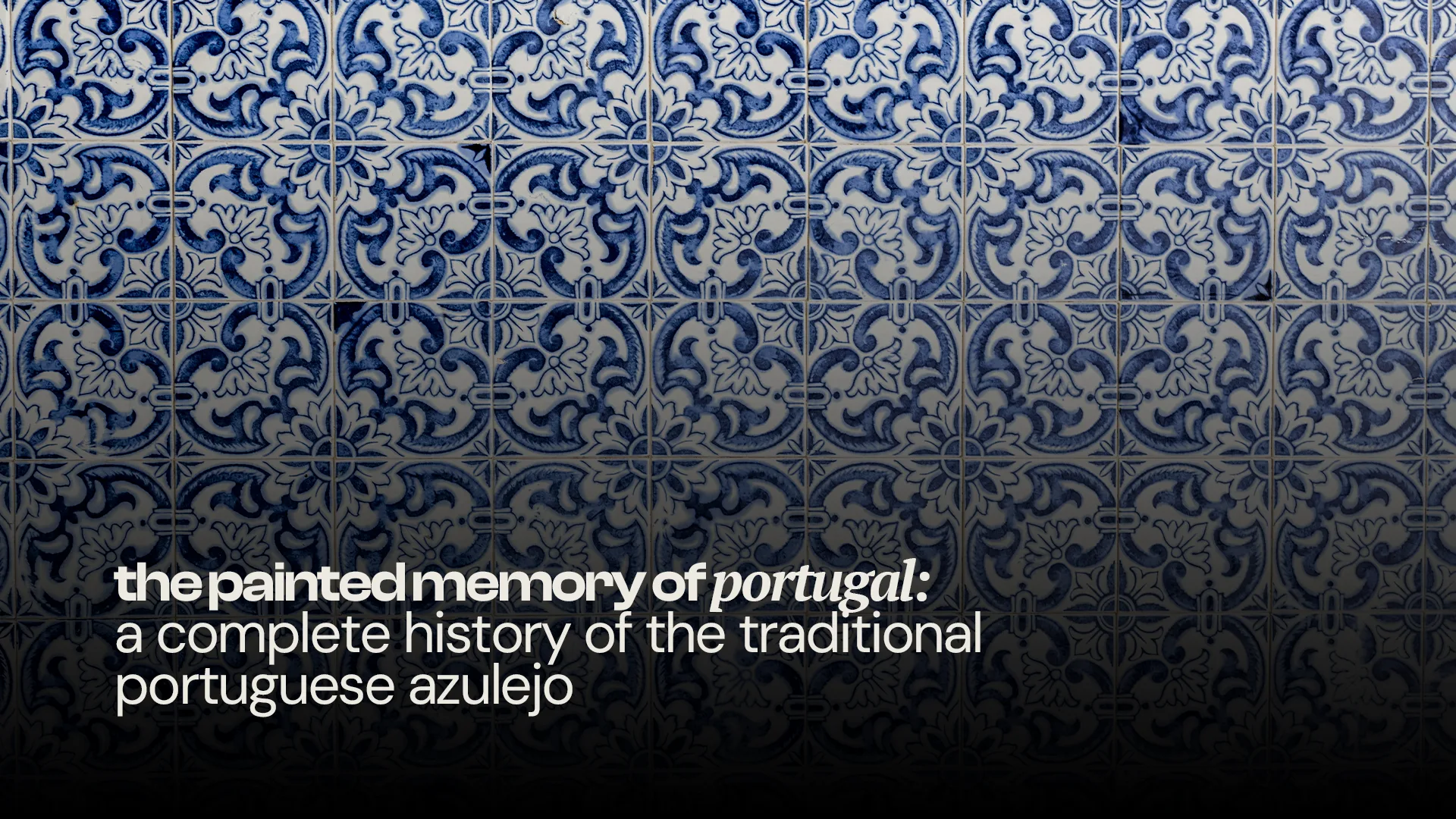
The Portuguese azulejo is not just a decorative tile. It is one of the most enduring visual languages in European culture. It covers churches, palaces, train stations, private houses, gardens, cloisters and urban façades. It tells religious stories, protects buildings, reflects light, records power, absorbs foreign influences and transforms them into something unmistakably Portuguese.
For tile., the azulejo is more than a historical reference. It is a symbol of how tradition can become a living system of design. Piece by piece, pattern by pattern, the azulejo shows how visual identity can be built through rhythm, repetition, craft and meaning.
The word “azulejo” comes from the Arabic al zulayj, meaning “little polished stone”. The term first referred to North African mosaic traditions and later became associated with decorated ceramic tiles, especially in Spain and Portugal from the 14th century onward.
from Islamic geometry to the Iberian wall
The origins of the azulejo are deeply connected to Islamic culture in the Iberian Peninsula. Islamic decorative arts placed great importance on geometry, symmetry, repetition and surface ornamentation. In religious contexts, figuration was often avoided, which encouraged the development of abstract patterns, mathematical compositions and highly sophisticated decorative systems.
This influence entered Portugal through the broader Hispano Moorish ceramic tradition. Early azulejos were not yet the blue and white painted panels we now associate with Portugal. They were often geometric, colourful and modular, using techniques such as alicatado, cuerda seca and aresta. These methods allowed different colours and shapes to form complex surface patterns.
In the late 15th and early 16th centuries, Portuguese elites began importing tiles from major Iberian production centres, especially Seville. One of the most important early moments was the use of Hispano Moorish tiles in the Palácio Nacional de Sintra, associated with the reign of King Manuel I. This marked the beginning of Portugal’s long relationship with architectural ceramics.
At this stage, the azulejo was still largely imported. But Portugal did something unique with it. Instead of treating it as a minor ornament, Portuguese architecture gradually turned it into a structural part of visual experience.
the arrival of painted tilework
The decisive transformation came with the development and adoption of majolica, also known as tin glazed earthenware. This technique created an opaque white surface that could be painted before firing. It changed everything.
The tile was no longer only a geometric unit. It became a small ceramic canvas.
This allowed artists and workshops to paint figures, landscapes, religious scenes, ornaments, symbols and narrative compositions. Walls could now tell stories. Interiors could become immersive pictorial environments. Architecture could be covered not only with pattern, but with image.
From the 16th century onward, Portugal began to develop a more independent azulejo tradition. Italian, Flemish and Spanish influences remained important, but Portuguese workshops started adapting these languages to local architecture, religious life and social taste.
This is where the azulejo becomes especially relevant for tile.: it shows that identity is rarely created from nothing. It is built by absorbing influences, refining them and turning them into a language with its own rhythm.
the 17th century: pattern, devotion and scale
By the 17th century, azulejo production in Portugal had become more established. Churches, convents, palaces and noble houses increasingly used tiles to cover large interior surfaces. This extensive architectural use became one of the defining features of Portuguese azulejo culture.
There were two major directions.
The first was the patterned tile. These tiles repeated motifs across walls, creating visual rhythm and surface continuity. They could be floral, geometric or ornamental. Their power came from repetition. A single tile might be simple, but hundreds of them together created a complete architectural atmosphere.
The second direction was the painted narrative panel. These panels represented biblical episodes, saints, allegories, historical events, mythological scenes, hunting scenes and landscapes. In religious spaces, they helped communicate doctrine and devotion visually. In palaces, they expressed status, taste and cultural sophistication.
The colours were not accidental. Scientific research on Portuguese azulejo pigments shows that the traditional palette used metallic oxides, including cobalt for blue, copper for green, manganese for purple and iron or manganese for darker brown tones.
The azulejo was therefore both art and chemistry. Its beauty depended on drawing, composition, firing, glaze, mineral pigment and workshop knowledge.
the rise of blue and white
The most iconic phase of the Portuguese azulejo emerged between the late 17th and 18th centuries: the blue and white painted tile.
This aesthetic was strongly influenced by the European fascination with Chinese porcelain. Blue and white porcelain had enormous prestige in Europe, and Portuguese tilework absorbed that visual language. The use of cobalt blue on a white background created a clean, luminous and highly readable image.
Blue and white azulejos had several advantages. They worked beautifully in large compositions. They created contrast without visual chaos. They could be read from a distance. They also carried associations of refinement, international taste and maritime connection.
In Portugal, this language became monumental. Walls were covered with large blue and white scenes, often framed by decorative borders. Churches, convents and palaces became ceramic theatres. The azulejo stopped being just a surface treatment and became a complete visual narrative.
This is one of the strongest lessons for tile.: a restricted visual system can still produce enormous expressive power. Limitation does not reduce creativity. It can intensify it.
the 18th century: the golden age
The 18th century is often seen as one of the great periods of Portuguese azulejo production. Baroque taste encouraged drama, movement, theatricality and emotional intensity. Azulejos fitted perfectly into this world.
In churches, blue and white panels worked alongside gilded woodcarving, sculpture, painting and architecture. The result was not minimal. It was total. Every surface participated in the experience.
In convents and cloisters, azulejos created long visual sequences. In palaces, they represented leisure, hunting, gardens, mythology and aristocratic life. In public and semi public spaces, they combined beauty with durability.
The azulejo also had practical value. It protected walls from humidity, was easier to clean than painted plaster and reflected light into interiors. In a country with Atlantic humidity and strong sunlight, this made ceramic wall covering both useful and beautiful.
After the 1755 Lisbon earthquake, reconstruction and urban transformation also encouraged more systematic approaches to building decoration. Tiles became increasingly important not only in religious and aristocratic spaces, but also in the broader urban fabric.
from interiors to façades
One of the most important changes happened in the 19th century: azulejos moved from interiors to exterior façades.
This transformed Portuguese cities.
In Lisbon, Porto and other urban centres, façades began to be covered with patterned tiles. These tiles protected buildings from rain, salt air and pollution, while also giving streets a strong visual identity. The city itself became a ceramic surface.
The 19th century also brought industrial production. Tiles could be made more efficiently and distributed more widely. This helped move the azulejo beyond elite spaces. It became part of everyday urban life.
The patterns of this period are often the ones people now recognise from Portuguese streets: floral motifs, geometric repetitions, relief tiles, glossy surfaces and strong colour combinations. The azulejo became democratic. It no longer belonged only to churches, palaces or convents. It belonged to the street.
a visual language of memory
What makes the Portuguese painted azulejo unique is not only its beauty. It is its ability to store memory.
A painted panel can record a saint’s life, a battle, a city, a landscape, a maritime scene or a social ritual. A patterned façade can identify a house, a neighbourhood or a period of urban history. A train station can become a public gallery. A church can become a visual book.
The azulejo works because it sits between image and architecture. It is not a framed painting that hangs on a wall. It is the wall.
This gives it a different relationship with the viewer. People do not simply look at azulejos. They walk beside them, enter rooms through them, pass them every day, remember places because of them.
craft, repetition and imperfection
Traditional painted azulejos are also a study in craftsmanship. The process involves preparing the ceramic body, drying it, firing it, applying glaze, painting the surface and firing it again. Each step affects the final result.
The painter must understand how pigments change in the kiln. The brushstroke has to be confident. The composition must be planned across multiple tiles. Small imperfections often remain visible, giving traditional azulejos their human quality.
This is why azulejos feel different from printed pattern. They carry the trace of the hand.
For tile., this is central. The azulejo represents a way of making where system and human detail coexist. It is modular, but not soulless. Repeated, but not empty. Structured, but still alive.
the 20th century and modern reinvention
The azulejo did not disappear with modernity. It adapted.
In the 20th century, Portuguese artists and architects brought azulejo into modern public space. One of the most important examples is the Lisbon Metro, where artists such as Maria Keil helped transform stations into modern ceramic environments. The azulejo became graphic, abstract and urban.
This reinvention proved that the azulejo was not just a historic object. It could become a contemporary medium. It could belong to modern architecture, public transport, schools, housing, civic buildings and cultural spaces.
That continuity is one of the reasons the azulejo remains so powerful today. It is heritage, but not frozen heritage. It is a living design language.
why the azulejo still matters
The traditional Portuguese painted azulejo matters because it contains several ideas at once.
It is craft. It is architecture. It is storytelling. It is protection. It is memory. It is identity.
It began through external influence, but became one of Portugal’s strongest cultural symbols. It moved from Islamic geometry to Iberian palaces, from religious interiors to urban façades, from blue and white Baroque panels to modern public art.
Its history proves that tradition is not the opposite of innovation. Tradition becomes powerful when it is reinterpreted.
That is why the azulejo remains so relevant to tile. It represents the possibility of building something contemporary from cultural depth. It reminds us that design is strongest when it has both structure and soul.
At tile., the azulejo is not treated as nostalgia. It is treated as a principle: small pieces, carefully placed, can build something much bigger than themselves.